
Nissim Ezekiel Biography

Nissim Ezekiel Life and Biography:- 
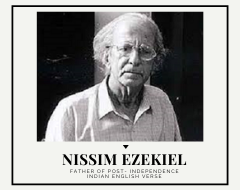

nissim ezekiel biography,nissim ezekiel death, nissim ezekiel religion,nissim ezekiel graduated from,nissim ezekiel poems,nissim ezekiel life,nissim ezekiel as a modern poet

Birth and Death:

Nissim Ezekiel an Indian Poet also is known as "Urban Ezekiel" was born on 16 December 1924 in a Jewish family in Bombay. He died on 9 January in the year 2004 (at the age of 70) due to Alzheimer. 

Nissim Ezekiel also considered the father of post-independence Indian English verse. He also considered as one who started modernity in Indian and English poetry. 

Studies:

He studied at Antonio D. Souza High School and took his graduation from Wilson College and Birkbeck College, London. He had the experience of teaching in school, college and at university also. In the year 1947, he took his post-graduate degree. Next year he went to England for his study in philosophy. Under the influence of MN Roy, he became a member of the Radical Democratic Party. After returning from England, in the year 1952, he brought out his first collection of poems under the title "Time to Change". After this, he started to work the Illustrated weekly of India.

Nature of Poetry:

His poem depicted the existence of religious beliefs and communal disharmony of the Indian Society. Yet his poetry shows extreme optimism of life, though filled with sorrows and pains. The themes that he usually used in his poems are love, loneliness, creativity and human foibles. He stressed the simplicity of thought and language in modern poetry.

Awards:

He achieved Sahitya Academic Award in 1983 for his book "Latter Dat Psalms",  and he also awarded for Padmasiri Award in 1988.

Works:

Plays:

  1. Nalini (Comedy)
  2. Marriage (Poem)
  3. The sleepwalkers

Poems:

  1. A time to change
  2. Philosophy
  3. The couple
  4. The night of the scorpion
  5. The visitor
  6. Sixty poem
  7. The unfinished man
  8. The Hill
  9. The protector
  10. The Patriot
  11. Lover
  12. The Birdwatcher
  13. Island
  14. Hymns in Darkness

More About Nissim Ezekiel:


For a short period, he worked as a lecturer in English at Khalsa College in Bombay. he also taught English at Bombay University. He had also been visiting professor at the University of Leeds. Nissim also worked for the magazine Quest as an Editor. In 1961, he returned to full time teaching as Head of the Department of English, where he taught until 1972. Ten years later he was made professor at this university and he retired from full time teaching in 1984.


More Links:

Comments

Post a Comment

Popular posts from this blog

THE SONG OF ENGINE - Christine Weatherly

Song of Engine:- Know Summary, Theme And Related Questions. We are presenting a wonderful, motivating poem written by  Christine Weatherly . In this poem, she personifies an Engine of a Train As A human. And she pictures what the train feels when she moves uphill and when she goes downhill. The writer did all this in a very beautiful rhyme, along with a wonderful message. So enjoy the poem. Poem When you travel on the railways, And the line goes up a hill, Just listen to the engine, As it pulls you with a will, Though it goes so very slowly  It sings this Little song, "I THINK I CAN, I THINK I CAN, " And so it goes along. But later on the journey, When you're going down a hill,  The train requires no pulling,  And the engine's singing still,  If you listen very quietly,  You will hear this little song,  "I THOUGHT I COULD. I THOUGHT I COULD! "  And so it speeds along. By - Christine Weatherly Summary: In the poem, the writer personifi...

The Laburnum Top Full Poem Analysis And Explanation

Know the Summary, Theme, Analysis, Literary devices and related Questions and Answers of the poem:   The Laburnum Top:- Analysis The poem The   Laburnum Top is a free verse poem written in 15 lines. In the first stanza of the poem, the poet used literary devices like alliteration ( September sunlight ) , consonance ( consonant 'S' is prominent in the second line )  and assonance ( vowel 'I' is prominent in the first line ) . In the second stanza of the poem, the poet used literary devices simile ( sleek as a lizard ) , metaphor ( as a machine ) , alliteration ( the thickness and tree trembles ) . Now coming to the ending of the poem, the poet used poetic devices like the metaphor ( It is the engine of her family ) . And throughout the poem, the poet also used onomatopoeia many times in the poem like chirrup, chittering, trillings, whistle-chirrup whisperings . Summary In the poem, The poet portrays his experience of what he witnesses about the Laburnum tree . T...

Why most people are annoyed of Rahat Indori?

Why most people are annoyed of Rahat Indori? Who was Rahat Indori? The soul of poet gatherings, poetic events, and mushairas , Rahat Indori, this was a renowned name in the industry of Urdu Gazals and sayaries, Dr. Rahat Indori won the heart of millions with their lovely and heart touching Gazals and sher over 40 years. Dr Indori was the man who spends more than 50 years of their life in the service of Urdu Poetry and Mushairas across the globe. He entertained and taught the values and understanding of life with the legacy of his poems.  So, before making any arguments why most people are annoyed with Rahat Indori, it is better to know about his background and what kind of life he spent, and what were the challenges in life, and after knowing these things, we will move through the political beliefs and controversies of Rahat Indori. Early Life: Dr Rahat Indori was born on 1st January 1950 in a town named Ranipura in Indore. Rahat Indori was the fourth child of his mother , Maqbool...